


PalmSens built its name on small, portable instruments. Less known is that the same lab now makes some of the most capable potentiostats on the bench — built to drive demanding cells, push real current, and resolve a signal across more than ten orders of magnitude.
This page shows what “powerful” means for a potentiostat, and which PalmSens instrument delivers it.
The powerful end of the PalmSens range
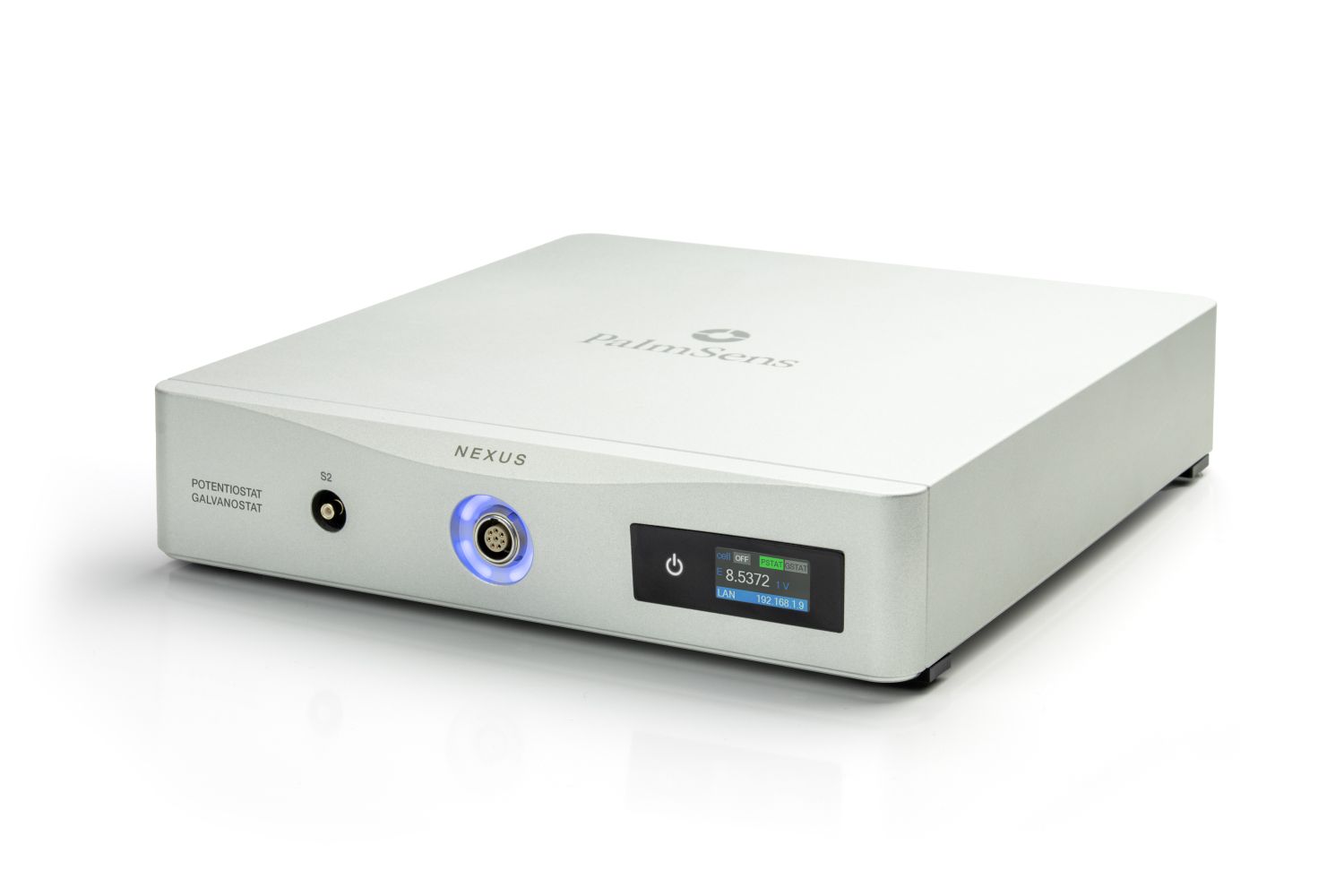
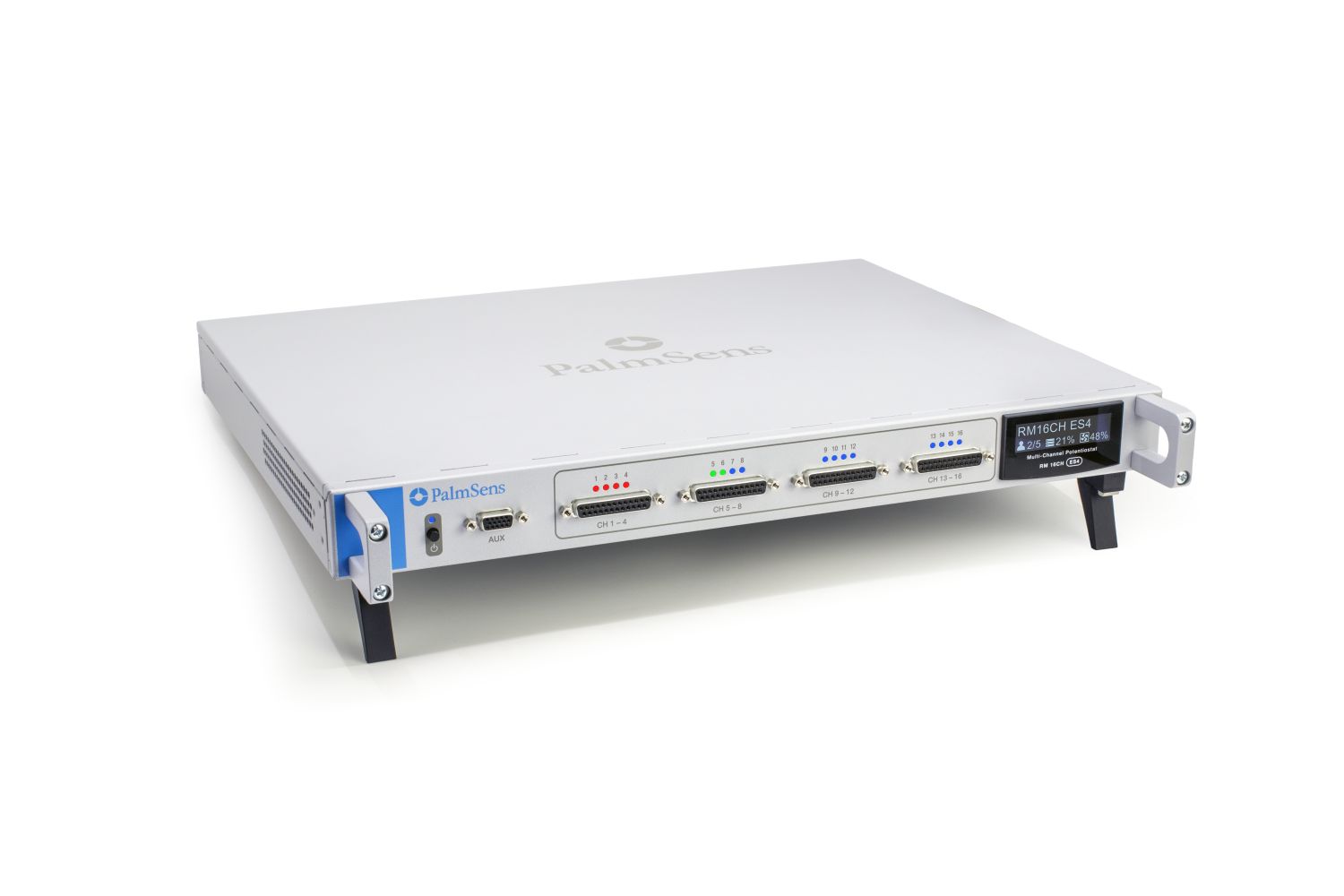
The Nexus is the flagship: ±12 V compliance, 100 pA to 1 A, resolution down to a few femtoamps and EIS to 1 MHz. When the work needs many of these channels at once, the range scales up to the MultiPalmSens4 and the RackMount 16CH.

Power is range, not size
A powerful potentiostat is not the biggest box on the bench. It is the one that keeps full control at both ends of the scale — the tiny currents of a microelectrode and the large currents of an electrolysis cell, the gentle potentials of a sensor and the high potentials a resistive cell demands.
Power in a potentiostat is range — the room to go from a few picoamps to a full ampere, and to stay in control when the cell fights back.
Four specifications decide how far an instrument reaches.
Compliance voltage
Compliance voltage is how hard the instrument can push to hold the potential you set. A resistive electrolyte, a coated electrode or a two-electrode battery can swallow several volts before the working electrode even reaches its target, and when the ceiling is too low the measurement simply clips.
The Nexus reaches ±12 V of compliance — enough for cells that stall lesser instruments.
Coin cells, electrolysers and coated coupons are the usual places this shows up. They look simple on paper and then sit several volts away from where you set them, which is exactly where the extra headroom earns its keep.

Current
Large electrodes, electrolysis, scale-up work and battery cells all draw current that a handheld cannot supply. The Nexus delivers up to 1 A, where a pocket-sized instrument tops out near 10 mA.
Dynamic range
The mark of a research-grade instrument is resolving the very small while still handling the very large. The Nexus spans 100 pA to 1 A across eleven current ranges, with resolution down to a few femtoamps on its lowest range.
One instrument, more than ten decades of current.
In practice that span means one instrument follows a microelectrode in the picoamp range and drives an electrolysis cell at a full ampere, without swapping hardware between experiments.

EIS bandwidth
Fast interfacial processes show up only at high frequency. The Nexus runs impedance spectroscopy from 10 µHz up to 1 MHz, with the low noise that clean high-frequency data needs.

And it scales to many channels
Power at the single-instrument level carries into parallel work. The MultiPalmSens4 runs four to ten channels and the RackMount 16CH sixteen, each channel with the same control.
Running several experiments at once is a different question — see the overview of multichannel potentiostats.
Contact a PalmSens expert
Talk to a specialist
Tell us about your cell and your current and voltage requirements, and we will point you to the instrument that fits.
Message us → Chat via WhatsApp
We usually respond within a business day · Mon–Fri 09:00–17:00 CET
Frequently asked questions
What makes a potentiostat powerful?
Not its size, but its range: a high compliance voltage to drive demanding cells, enough current for large electrodes and electrolysis, a wide dynamic range from picoamps to amps, and the EIS bandwidth to follow fast processes.
What is compliance voltage, and why does it matter?
It is the maximum voltage the instrument can apply between the working and counter electrode to reach the potential you set. Resistive cells, coatings and two-electrode batteries need headroom; a low ceiling clips the measurement. The Nexus offers ±12 V.
Which PalmSens potentiostat is the most powerful?
The Nexus — ±12 V compliance, 100 pA to 1 A, resolution to a few femtoamps and EIS to 1 MHz.
How much current can a PalmSens potentiostat deliver?
Up to 1 A with the Nexus, against roughly 10 mA for the portable instruments.
Can a powerful potentiostat also run many channels?
Yes, but that is a separate capability. For parallel measurements the range scales to the MultiPalmSens4 and the RackMount 16CH — see the multichannel potentiostat page.
Is a powerful potentiostat the same as a multichannel potentiostat?
No. Powerful is about the range of one channel — voltage, current, dynamic range and bandwidth. Multichannel is about running several measurements in parallel. The two can combine, but they answer different questions.