


A single measurement only ever tells part of the story. A voltammogram shows what happens at the electrode, but not what the molecules in solution are doing while it happens. Spectroelectrochemistry closes that gap by watching the same reaction with light and with current at once.
A spectro-electrochemical potentiostat is a potentiostat set up for exactly this: it drives the redox reaction while a spectrometer records the light. This page explains what such a setup needs, and which PalmSens instruments and cell make it work.
Potentiostats for spectroelectrochemistry
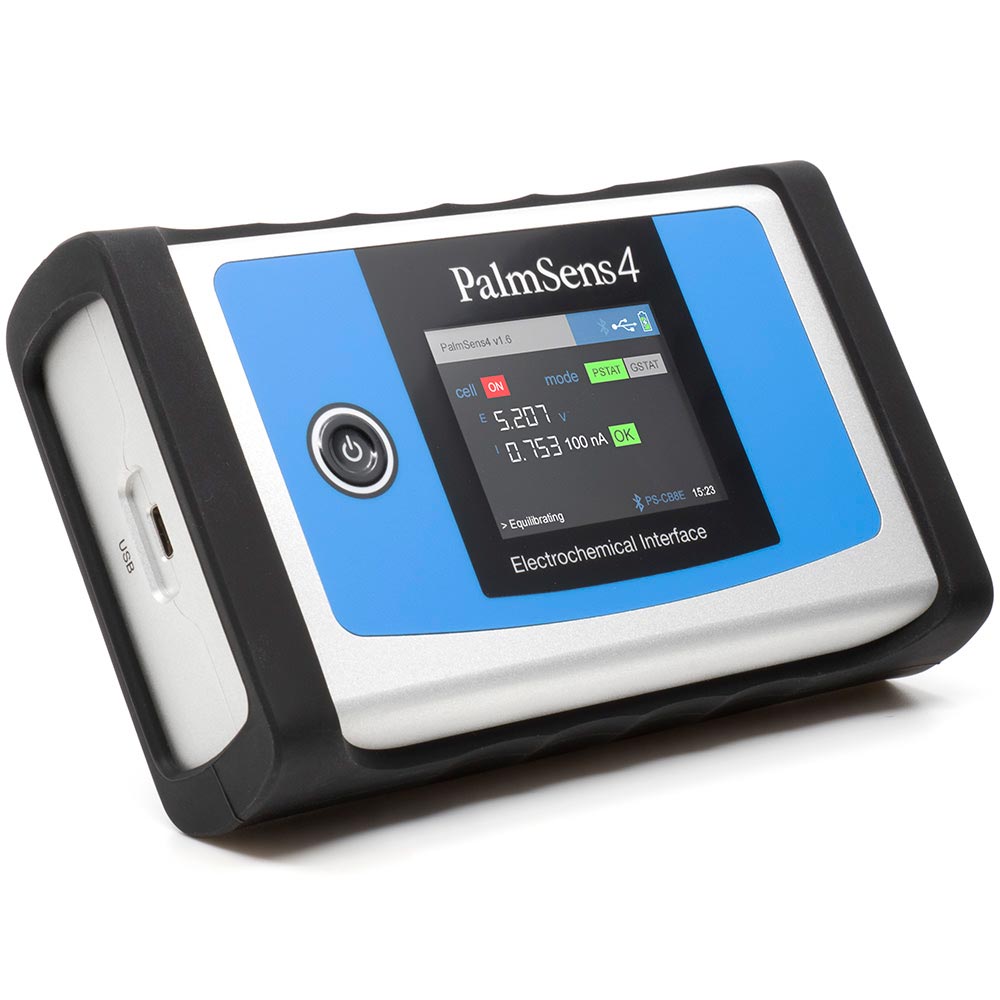
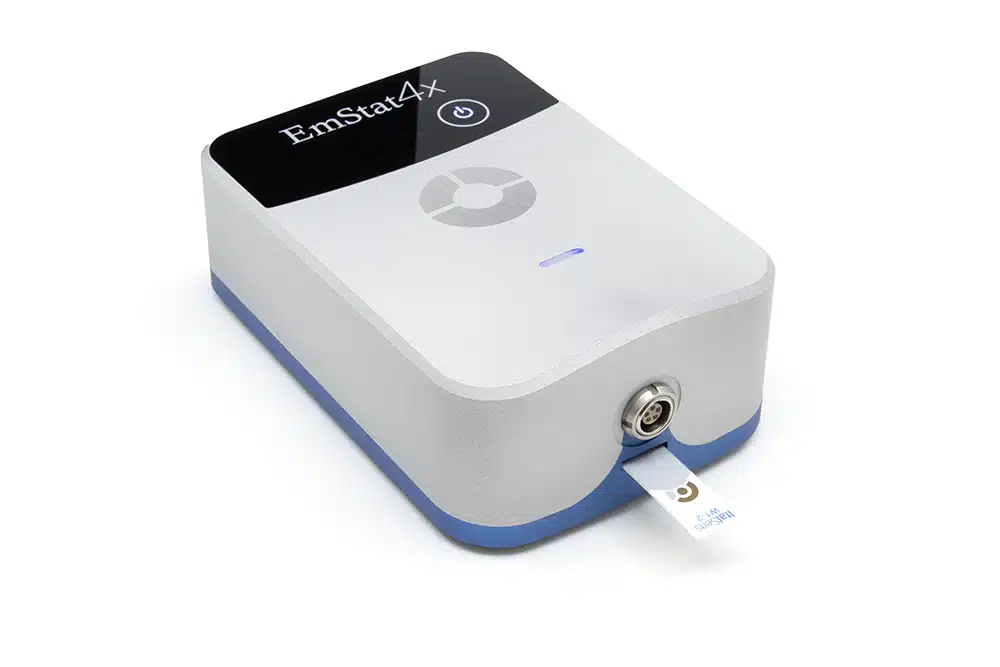
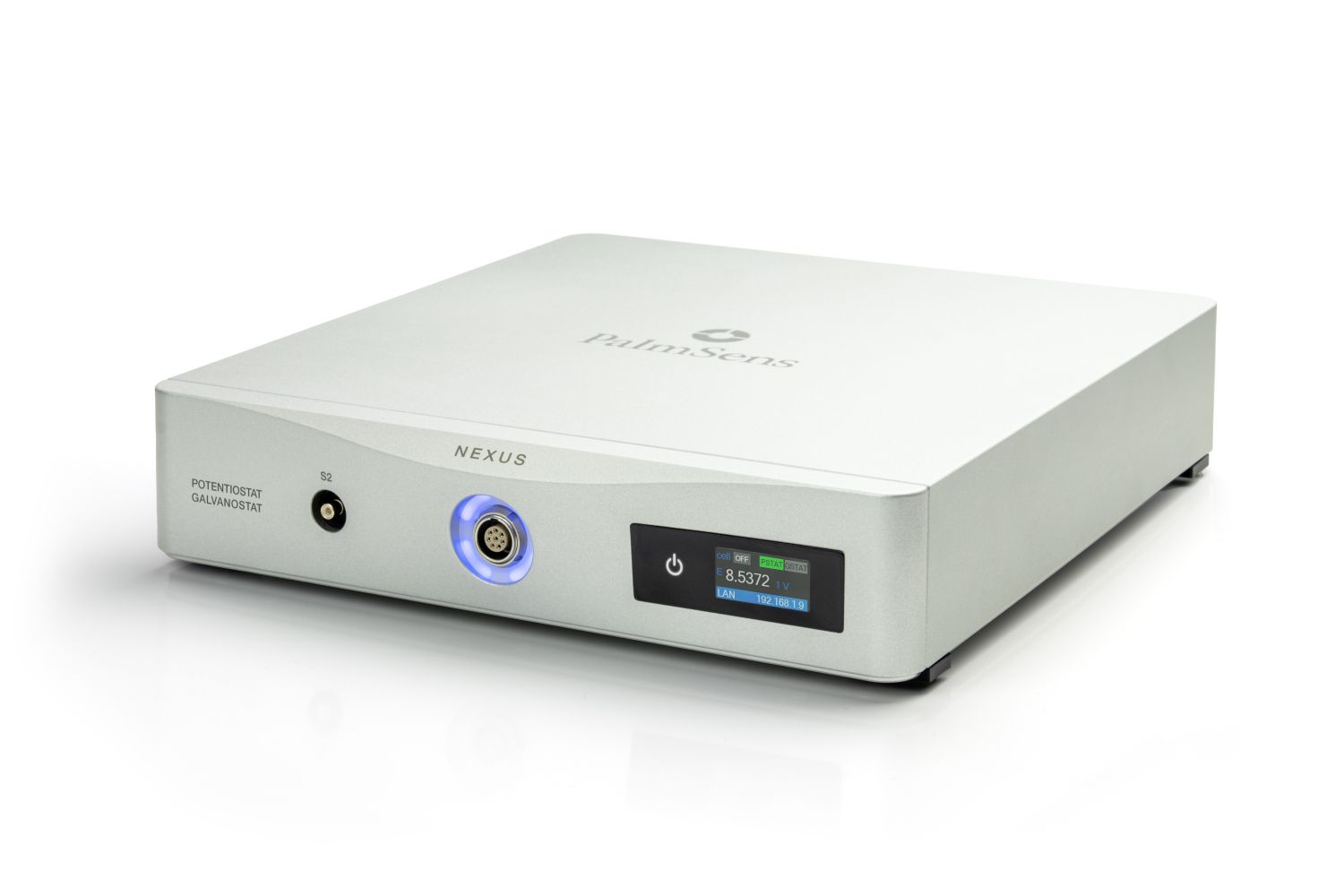
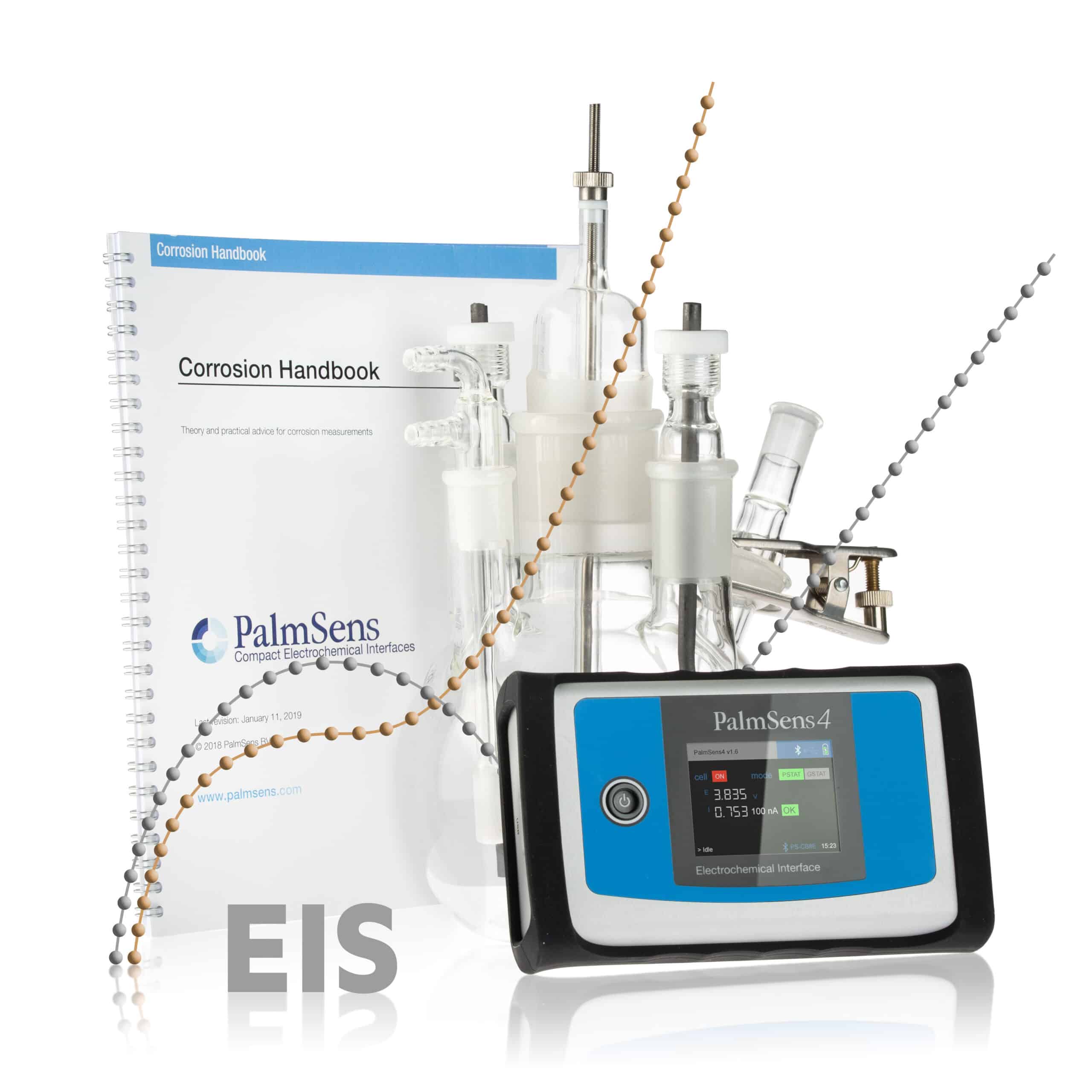
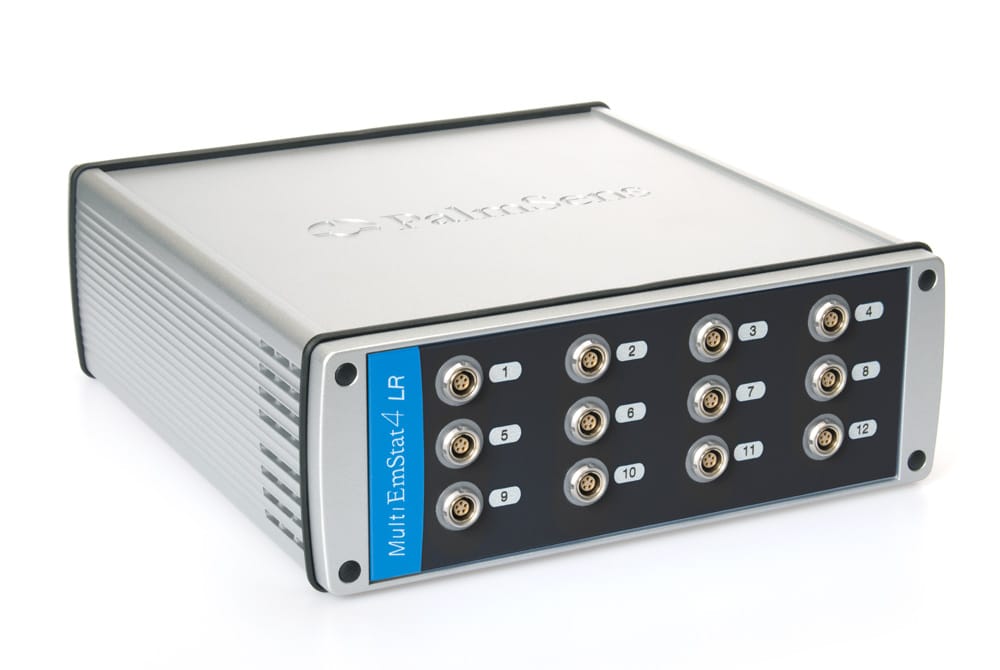
Start with the complete Spectroelectrochemistry Kit, or choose the instrument that matches your samples: the portable PalmSens4, the wireless EmStat4X, or the high-sensitivity Nexus.

What is spectroelectrochemistry?
Spectroelectrochemistry is a hyphenated technique that combines an electrochemical method, such as cyclic voltammetry or chronoamperometry, with a spectroscopic method, such as UV-Vis absorbance, to observe the same system at the same time.
The potentiostat drives a redox reaction at the working electrode while a spectrometer records how the sample absorbs or transmits light. One instrument reports the current and charge; the other reports which species are present and in what amount. Because the two signals are recorded together, a short-lived product of oxidation or reduction can be identified by its spectrum before it decays.
Electrochemistry tells you that a reaction happens. Spectroscopy tells you what is formed while it does.
Why combine electrochemistry with spectroscopy
The two techniques carry different, complementary information. Electrochemistry is sensitive to electron transfer and reaction rates; spectroscopy identifies molecules and follows their concentration.
Measured apart, they leave gaps. Measured together, they let you assign a redox peak to a specific coloured species, follow the build-up of an intermediate in real time, and study the kinetics and reversibility of a reaction in one experiment.
That is why spectroelectrochemistry is used across electrocatalysis, sensor development, battery and materials research, and the study of electrochromic and redox-active compounds.

What a potentiostat needs to run spectroelectrochemistry
The electrochemistry side of a spectroelectrochemical measurement is ordinary cyclic voltammetry or chronoamperometry. What sets the instrument apart is how well it talks to the spectrometer and how small a current it can resolve.
The key feature is an auxiliary port. A digital output on the potentiostat triggers the spectrometer, so light and current start recording together, and an analog input reads the spectrometer’s signal back, so transmittance at a chosen wavelength appears in the same window as the voltammogram.
Sensitivity matters because optically thin cells hold little sample and the resulting currents are small. A wide set of low current ranges keeps those currents on scale with low noise, and support for CV, chronoamperometry and multistep amperometry covers the methods used in spectroelectrochemistry.
Which potentiostat fits spectroelectrochemistry
The instrument cards above cover the choice; which one fits comes down to your samples and how you work.
For most UV-Vis spectroelectrochemistry the PalmSens4 is the natural starting point — portable, battery-powered and the instrument used in the application note.
When the setup has to be wireless or built into a compact, integrated rig, the EmStat4X is the better match.
And when the currents are very small, or you want the lowest noise and highest sensitivity, the Nexus is the one to reach for.

The spectroelectrochemical setup
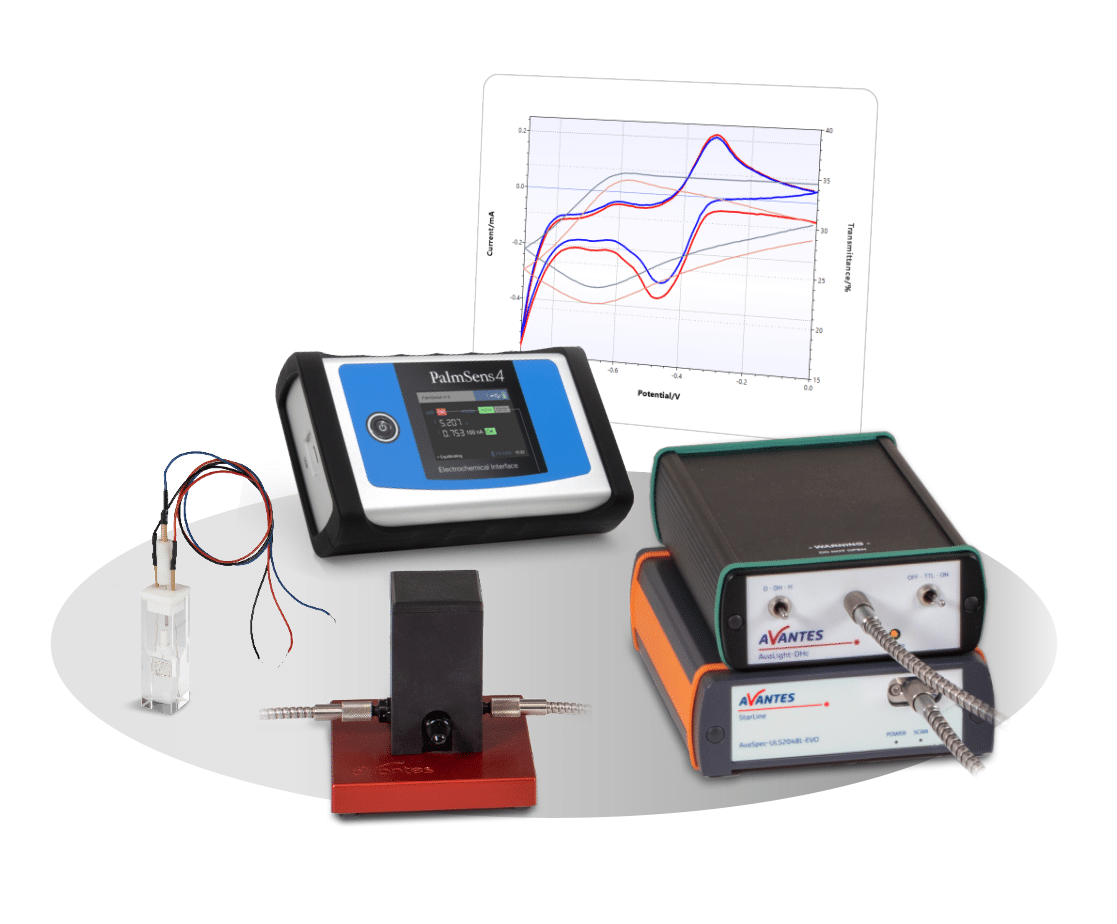
A spectroelectrochemical measurement adds an optical path to a normal three-electrode cell. In the PalmSens setup the cell is an ItalSens K300 cuvette with a platinum mesh working electrode, a platinum wire counter electrode and a reference electrode, so light can pass through the solution while the reaction runs.
Around the cell sit a UV-Vis spectrometer, a light source, two optical fibres and a cuvette holder, with the potentiostat linked to the spectrometer by a single cable. PalmSens works with Avantes for the optics, so the kit ships as a matched bundle.
The potentiostat runs in PSTrace and the spectrometer in its own software. A dark and a reference measurement set the baseline; from there the digital trigger keeps both recordings in step.

From a single wavelength to a full 3D spectrum
Three measurements cover most needs. The simplest records transmittance at a single wavelength during a cyclic voltammetry scan, so a rise or fall in absorbance lines up with a redox peak.
The next records a full spectrum at intervals during a chronoamperometry experiment, so you watch a species build up over time. The third combines a CV scan with full spectra into a 3D plot of wavelength against absorbance against time or potential.
A classic demonstration is methyl viologen. Its colourless form becomes a blue radical on reduction and absorbs around 600 nm, so the colour change seen by the spectrometer maps directly onto the current measured by the potentiostat.
Start with the Spectroelectrochemistry Kit
The fastest way to begin is the Spectroelectrochemistry Kit, which pairs a PalmSens potentiostat with the cell, cables and a matched Avantes spectrometer, light source and fibres.
E-mail or call for a quotation, or to talk through which instrument fits your samples and techniques.
Related pages
For the step-by-step method, see the spectroelectrochemistry application note. To get everything in one box, see the Spectroelectrochemistry Kit.
Instruments: PalmSens4, EmStat4X and Nexus. Background: cyclic voltammetry and what a potentiostat is.
Frequently asked questions
What is spectroelectrochemistry?
It is a combined, or hyphenated, technique that runs an electrochemical method and a spectroscopic method on the same sample at the same time, so a redox reaction can be followed both by the current it produces and by the light its species absorb.
What is a spectroelectrochemical cell?
A cell that lets light pass through the sample while a three-electrode measurement runs. It typically uses an optically accessible working electrode, such as a platinum mesh or a transparent electrode, inside a cuvette so a spectrometer can read the solution.
Which potentiostat is best for spectroelectrochemistry?
The PalmSens4 suits most UV-Vis spectroelectrochemistry and is the instrument used in the application note. The EmStat4X fits wireless, compact setups, and the Nexus is the choice when the currents are very small or the highest sensitivity is needed.
How are the potentiostat and spectrometer synchronised?
Through the potentiostat’s auxiliary port. A digital output triggers the spectrometer at the start of the measurement, and the spectrometer’s analog output can be read back into the potentiostat, so both results appear in one window.
Which techniques can you run?
The electrochemistry is usually cyclic voltammetry or chronoamperometry. You can record transmittance at a single wavelength during a CV scan, a full spectrum at intervals during chronoamperometry, or combine both into a 3D plot of wavelength, absorbance and time or potential.
Can I measure more than UV-Vis?
UV-Vis absorbance is the most common pairing, but the same principle of running electrochemistry and spectroscopy together applies to other optical methods. The PalmSens setup is built around UV-Vis.