


RackMount 16CH
16-channel potentiostat / galvanostat / EIS analyzer
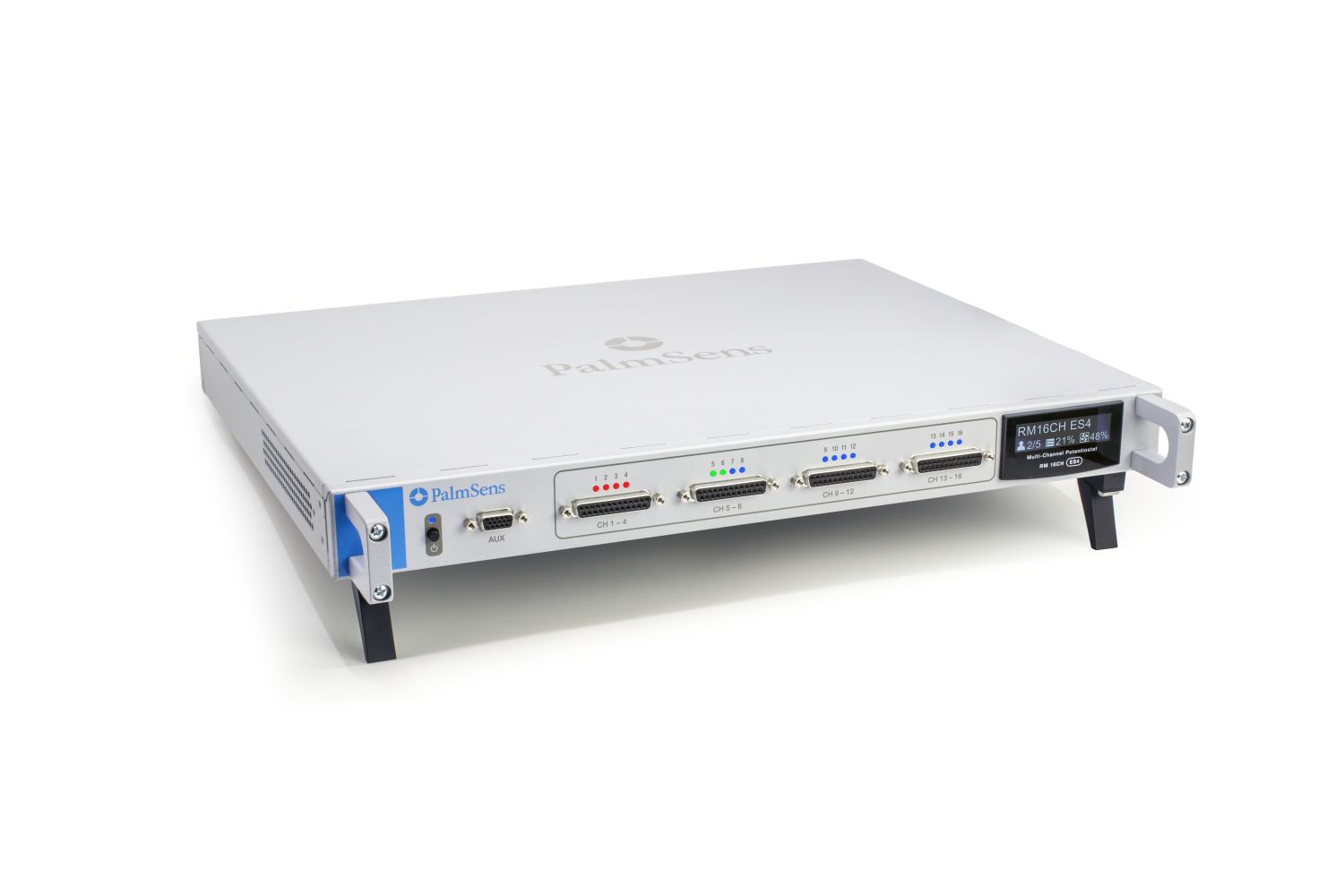
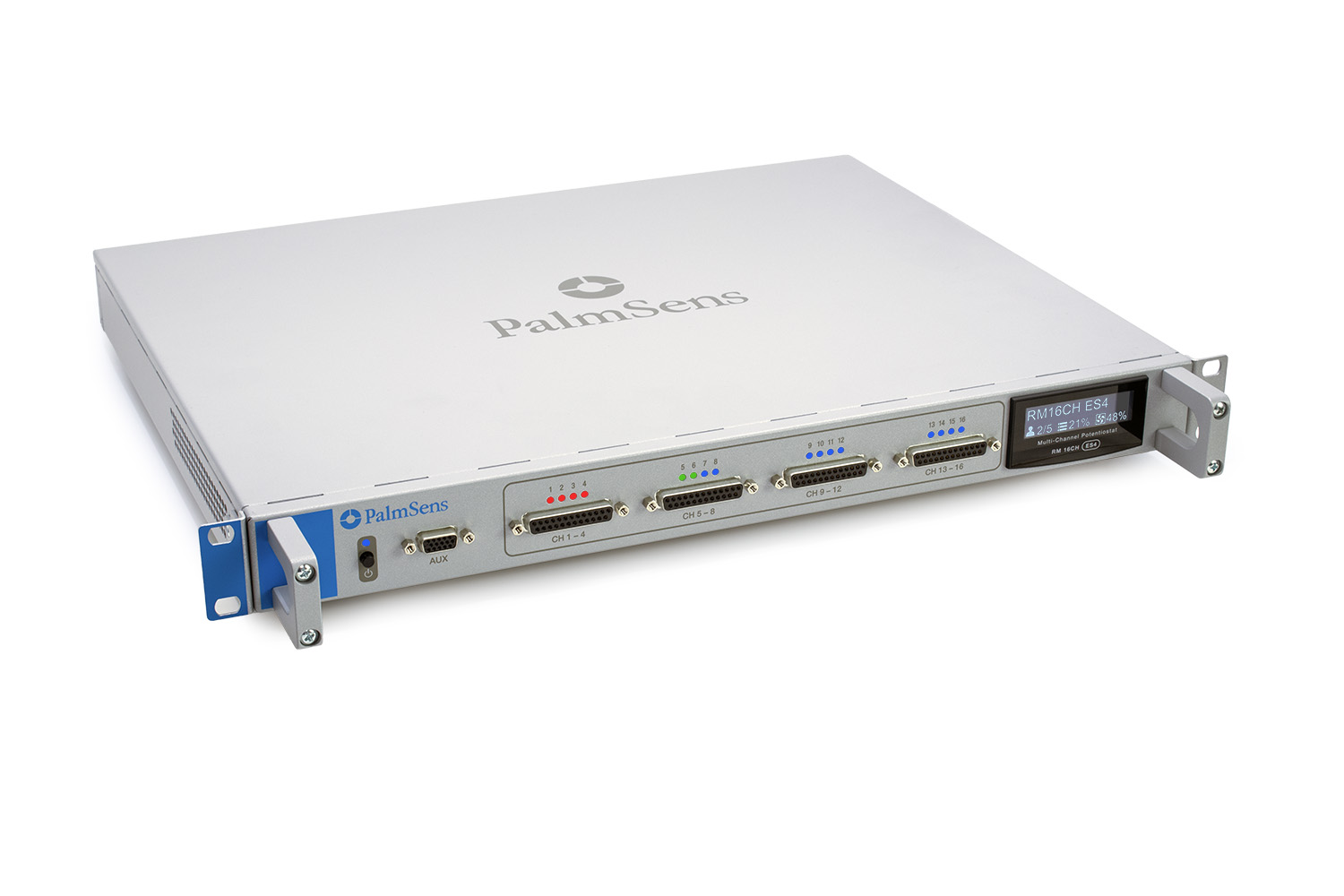
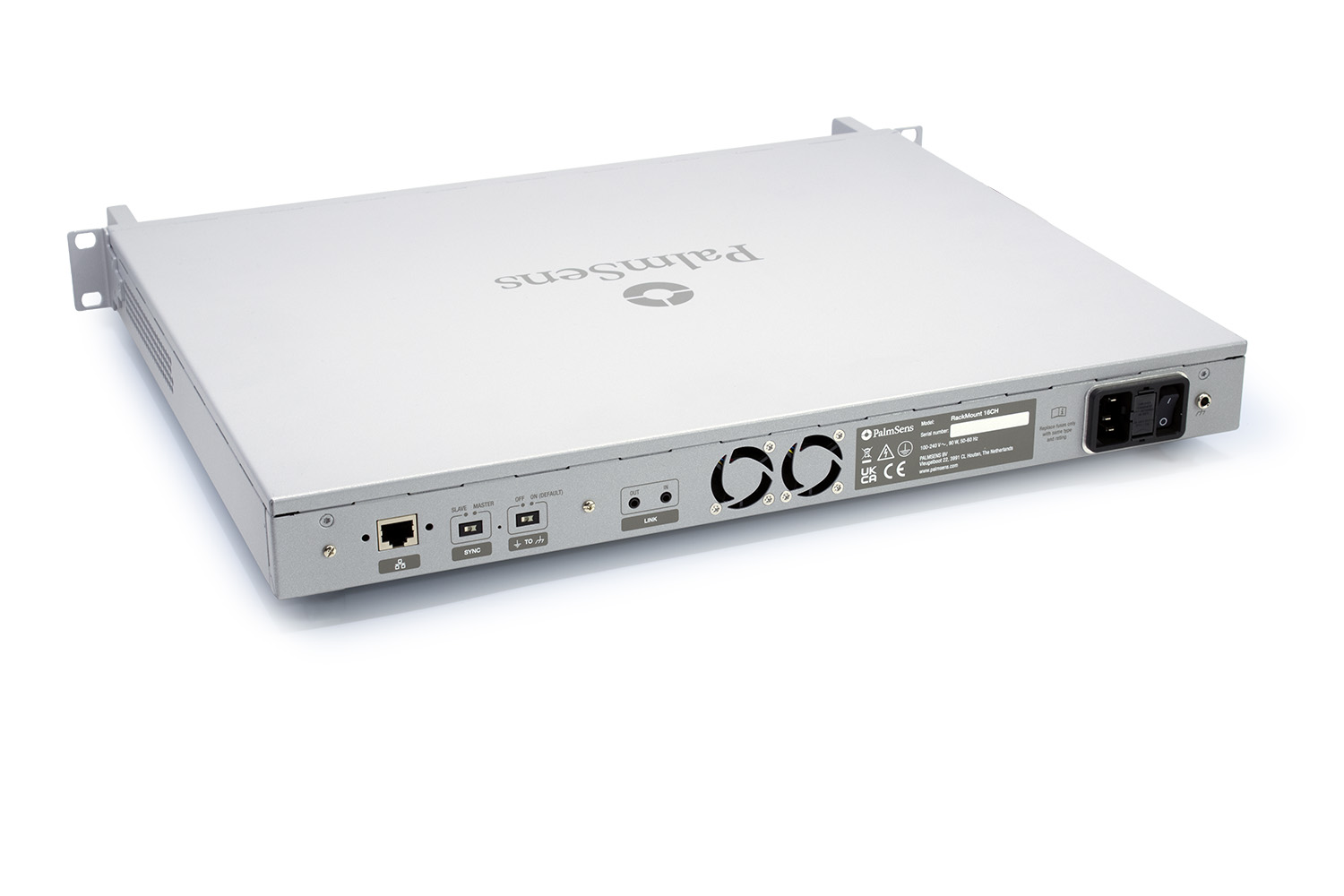
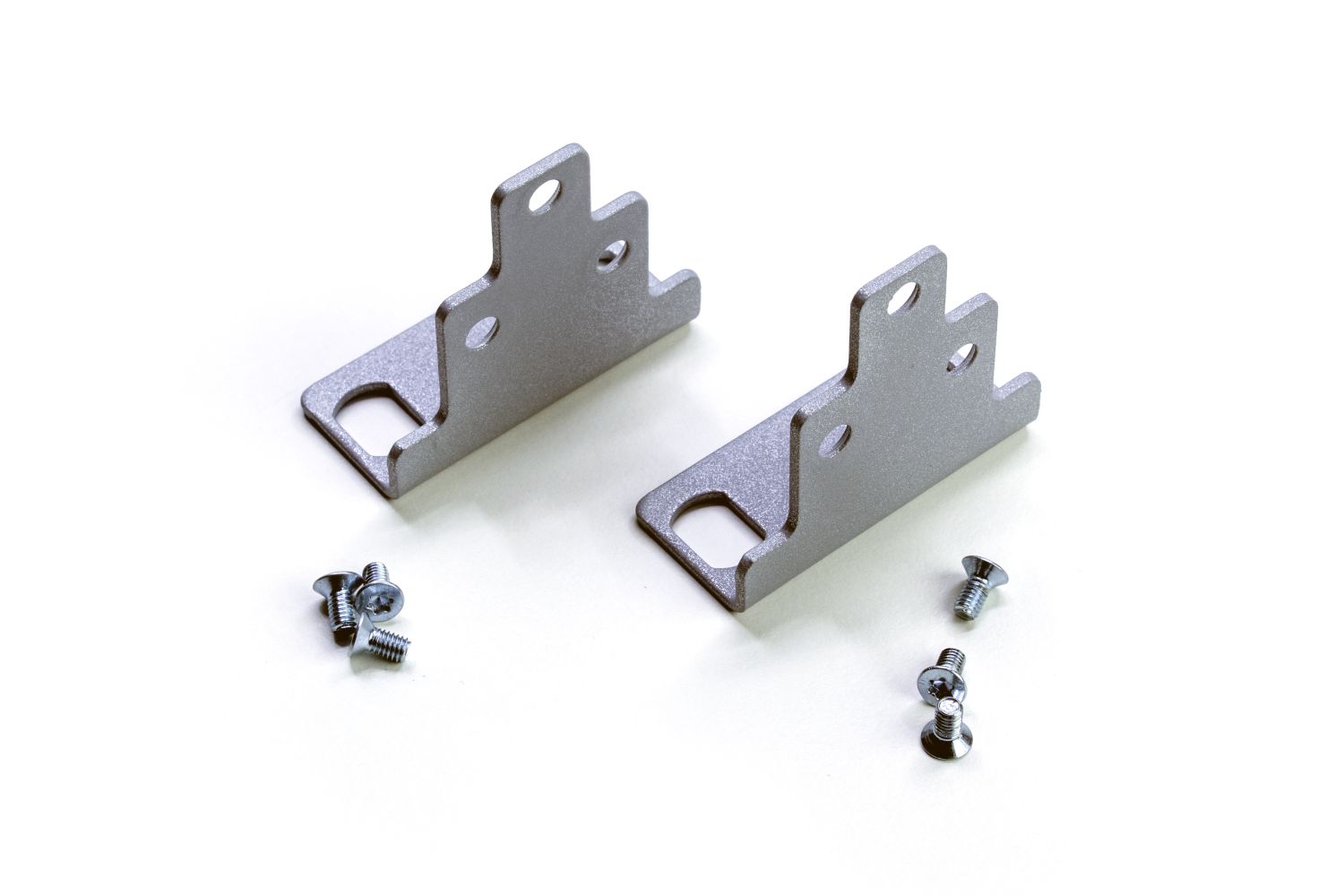
- Desktop or 19 inch rack-ready housing
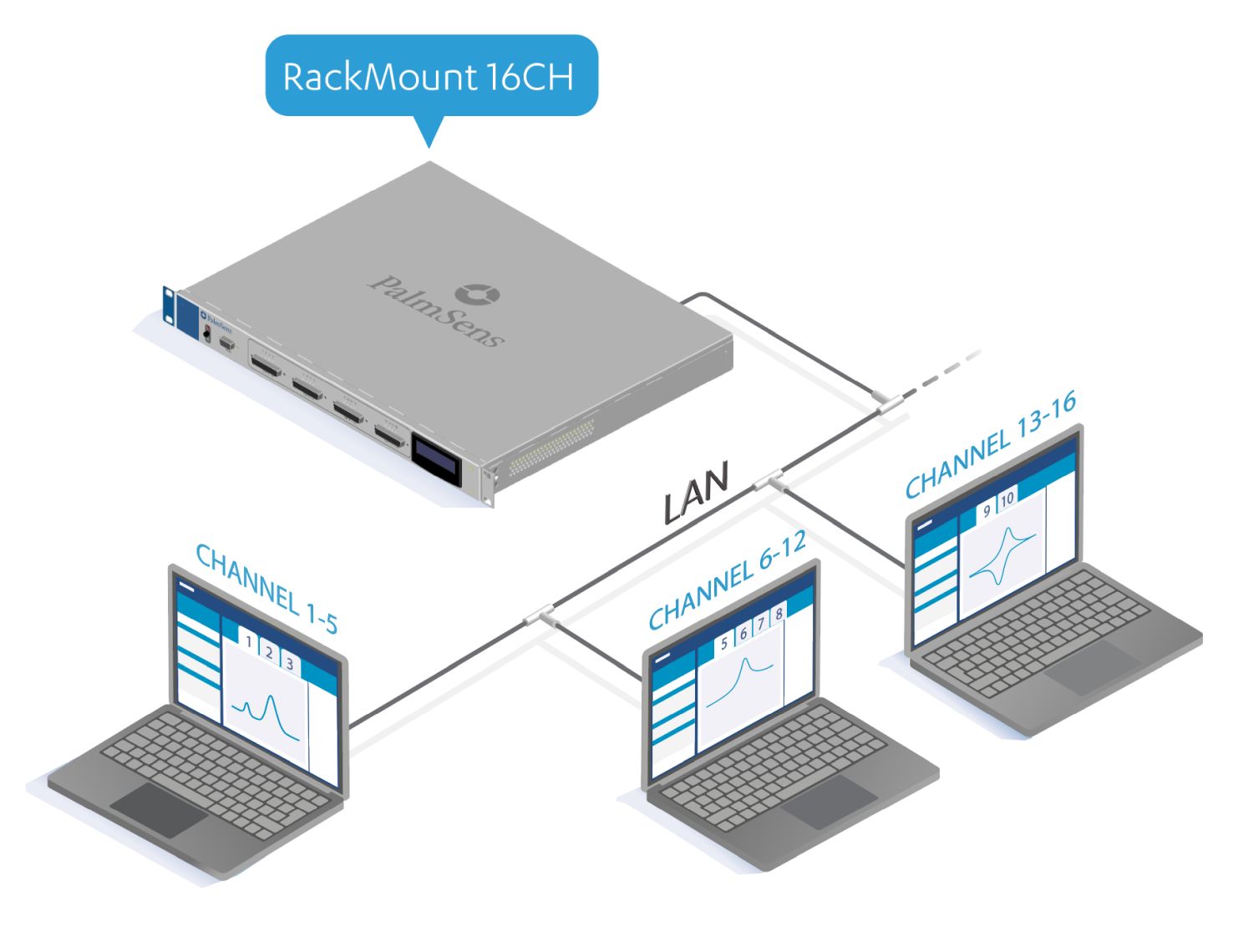
- Embedded Lablink Hub
- FRA / EIS: 10 µHz up to 200 kHz
- Potential range: ±3 V
- Max. current: ±30 mA

 You'll usually get an answer to your quotation request within one business day.
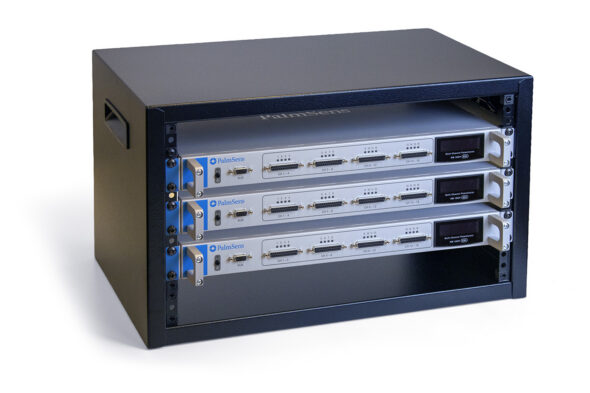
High-Throughput Networked Electrochemical Analyzer
The RackMount 16CH is a high-performance 16-channel potentiostat built on the industry-proven EmStat4 LR platform. Engineered for high-throughput electrochemical research, it delivers precise, simultaneous measurements across all channels without compromise. Equipped with an embedded Lablink controller, the RackMount 16CH manages, buffers, and stores every data point locally. Your experiments remain uninterrupted and your data stays safe.

16 independent channels
Each quad-cell connector interfaces with four independent electrochemical cells. Every channel features its own dedicated potentiostat with discrete Reference Electrode, Working Electrode, Counter Electrode, and ground connections for total isolation and control. Galvanic Isolation across the channels and hardware synchronization allow for using multiple Working Electrodes in the same cell.
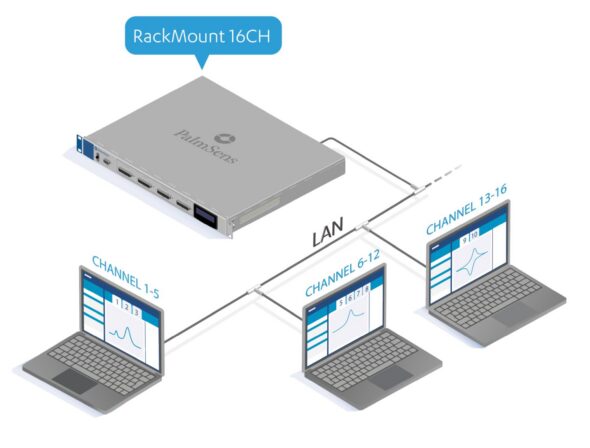
Embedded Lablink controller
The RackMount 16CH, powered by Lablink, controls your measurements internally and logs them directly to its onboard Solid State Drive (SSD).
- Independent Operation: Experiments run flawlessly without a PC connection.
- Internal Logging: Data is saved locally, eliminating the risk from software interruptions.
- Seamless Recovery: Simply reconnect to review and download your secured results

Status indicators and display
Each channel of the RackMount 16CH has a status indicator LED, showing if channels are available or claimed by users or if a measurement is running. The RackMount 16CH display shows Lablink-related status information and the fan speed.
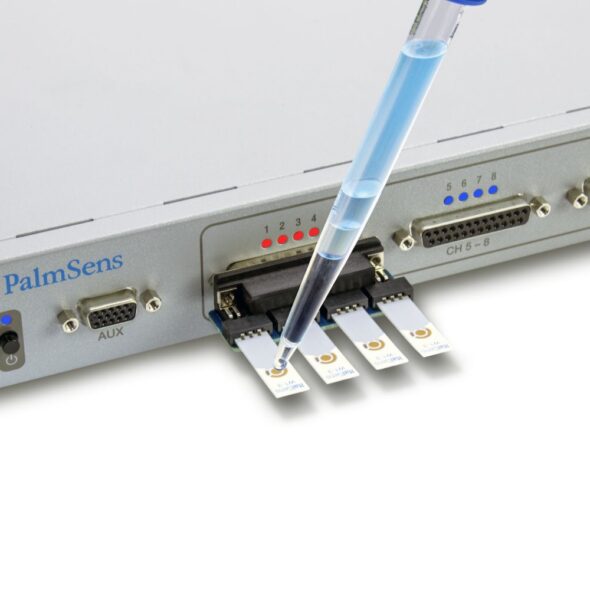
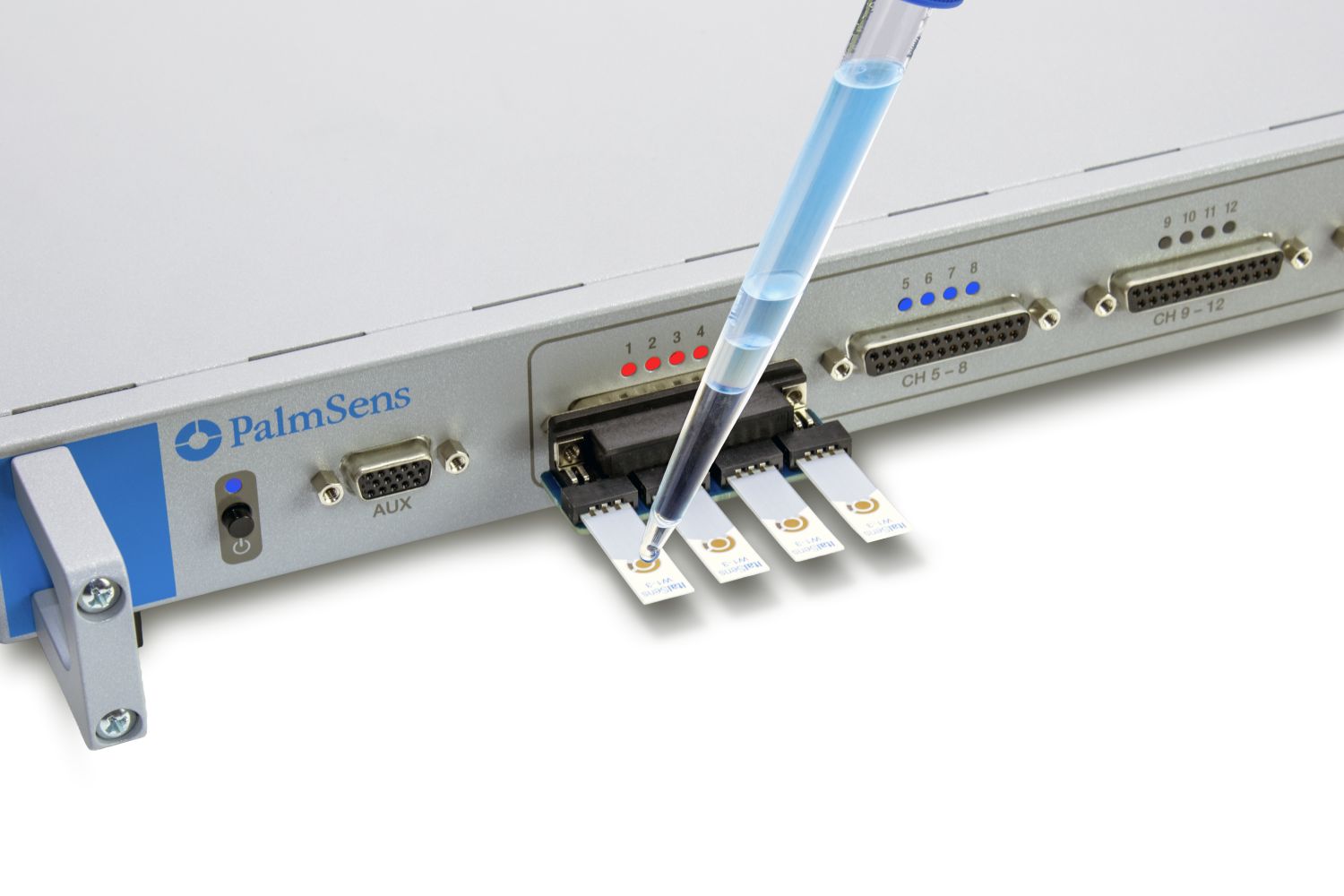
Automatic droplet detection
Optimized for Screen-Printed Electrodes (SPEs), each channel can be configured via software to trigger measurements automatically upon droplet detection. This minimizes the delay between
sample deposition and data acquisition, ensuring you capture the most time-sensitive electrochemical responses. It can also help streamline high-throughput workflows.

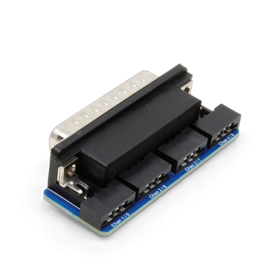
Adapter with shared Reference and Counter electrodes
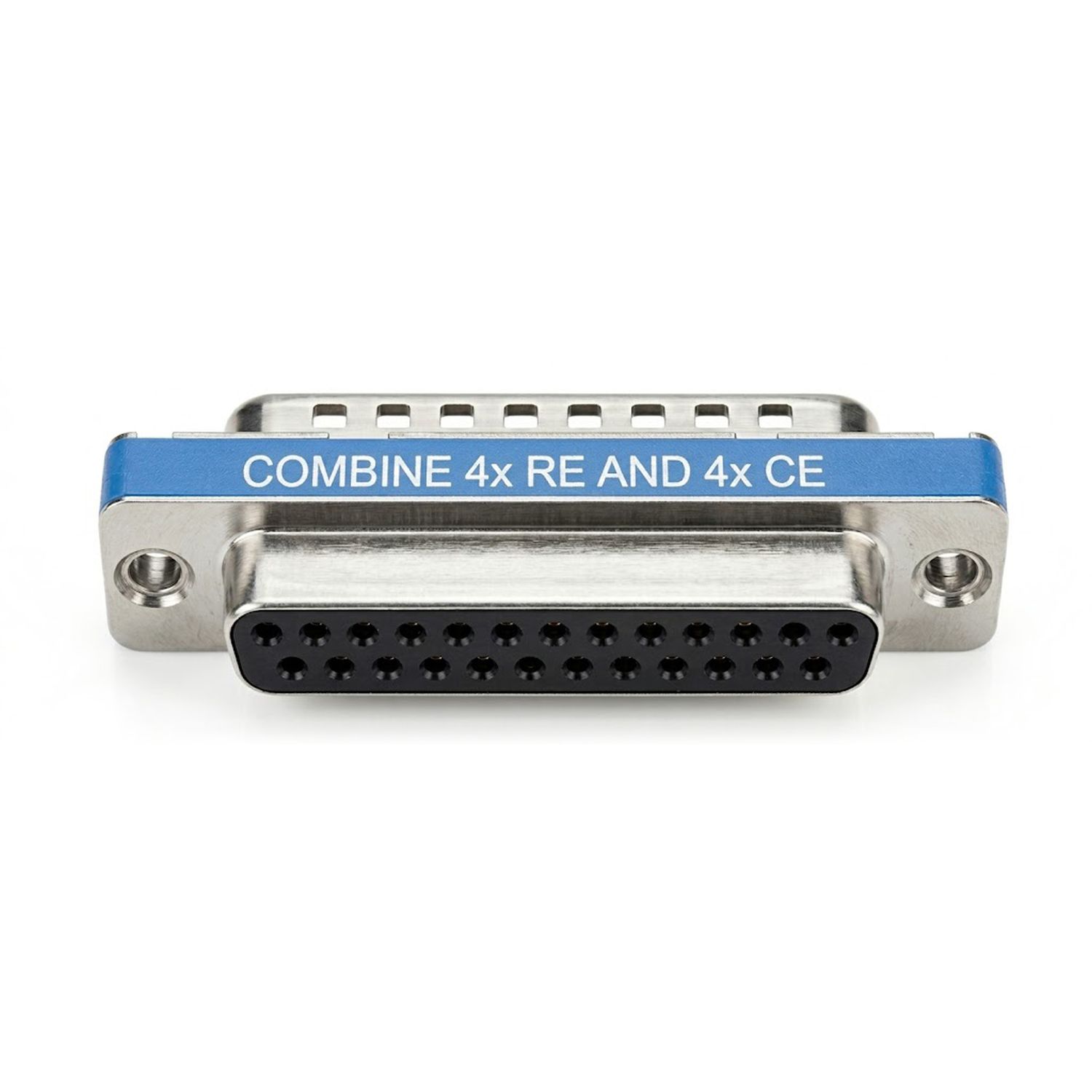
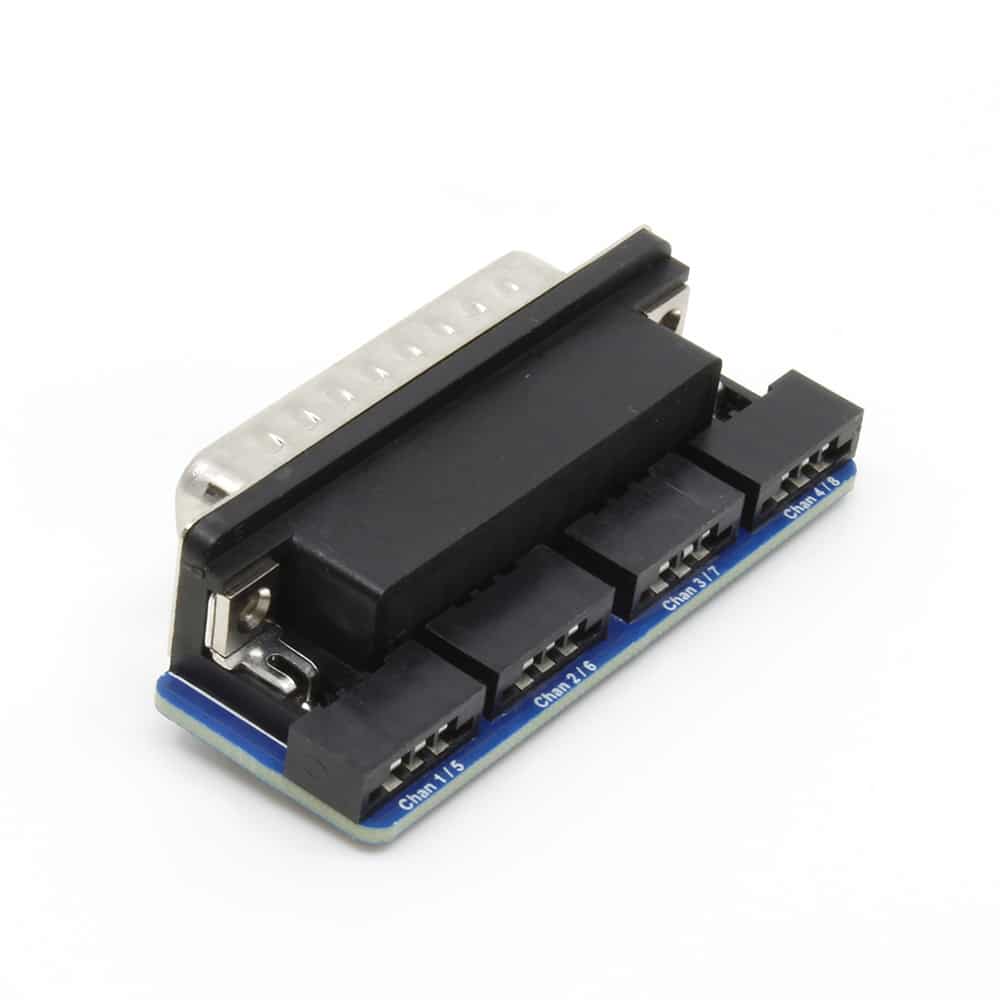
Every RackMount 16CH includes four cell-connector adapters as standard. These DB25 interfaces internally bridge the Reference (RE) and Counter (CE) electrodes for each four-channel bank, eliminating the need to manually stack leads at the cell.
Specifications
| General | |
|---|---|
dc-potential range
The maximum potential difference, that can be applied between WE and RE.
|
±3 V |
compliance voltage
The compliance voltage is the maximum voltage that can be applied between the working and counter electrode. Another name could be the maximum cell potential. Continue reading
|
±5 V |
| maximum current | ±30 mA |
max. data acquisition rate
Also known as Sampling Rate, it describes how fast the instrument can collect measurement values. Continue reading
|
1M samples /s |
| Potentiostat | |
|---|---|
| applied potential resolution | 100 µV |
applied potential accuracy
The applied potential accuracy describes how close to the real values your applied potential is.
|
≤ 0.2% ±1 mV offset |
current ranges
A current range defines the maximum current a potentiostat can measure in a certain range. Continue reading
|
1 nA to 10 mA 8 ranges |
measured current resolution
The lowest observable difference between two values that a measurement device can differentiate between. Continue reading
|
0.009% of CR (92 fA on 1 nA range)
CR is the acronym we use for Current Range. A current range defines the maximum current a potentiostat can measure in a certain range. Continue reading
|
| measured current accuracy
The current accuracy describes how close to the real values your measured current is. Continue reading
|
< 0.2% of current ±20 pA ±0.2% of range |
bandwidth settings
Bandwidth defines the range of frequencies a system can accurately measure or respond to. Continue reading
|
320 Hz, 3.2 kHz, 30 kHz or 570 kHz |
| Galvanostat | |
|---|---|
current ranges
A current range defines the maximum current a potentiostat can measure in a certain range. Continue reading
|
10 nA, 1 uA, 100 uA, 10 mA 4 ranges |
| applied dc-current | ±3 * CR (current range)
CR is the acronym we use for Current Range. A current range defines the maximum current a potentiostat can measure in a certain range. Continue reading
|
| applied dc-current resolution | 0.01% of CR |
| applied dc- current accuracy
The current accuracy describes how close to the real values your measured current is. Continue reading
|
<0.4% of current ±20 pA ±0.2% of range |
| potential ranges |
50 mV, 100 mV, 200 mV, 500 mV, 1 V |
| measured dc-potential resolution |
96 µV at ±3 V (1 V range) |
| measured dc-potential accuracy | ≤ 0.2% ±1 mV offset |
bandwidth settings
Bandwidth defines the range of frequencies a system can accurately measure or respond to. Continue reading
|
320 Hz, 3.2 kHz, 30 kHz or 570 kHz |
| FRA / EIS | |
|---|---|
| frequency range | 10 µHz to 200 kHz |
| ac-amplitude range |
1 mV to 900 mV rms, or 2.5 V p-p |
| GEIS | |
|---|---|
| frequency range | 10 µHz to 100 kHz |
| ac-amplitude range |
0.9 * CR (Arms)
CR is the acronym we use for Current Range. A current range defines the maximum current a potentiostat can measure in a certain range. Continue reading
|
| Electrometer | |
|---|---|
electrometer amplifier input
The amplifier input resistance of the amplifier in the electrometer determines the load that the amplifier places on the source of the signal being fed into it. Ideally the resistance is infinite, and the load to be zero to not to influence your measurement.
|
> 1 TΩ // 10 pF |
bandwidth
Bandwidth defines the range of frequencies a system can accurately measure or respond to. Continue reading
|
10 kHz default or 500 kHz for EIS and fast CA/CP |
| Other | |
|---|---|
| electrode connections |
16 x [ WE, RE, CE, and ground, with 2 mm banana plugs ] |
| housing |
Steel 19” housing: |
| weight |
4.5 kg |
| communication |
ethernet, I2C for peripheral control |
| Power |
100-240 V, 90 W, 50-60 Hz |
| internal storage space |
500 MB, equivalent to > 15M datapoints or ~1000 measurement files per channel plus 512 GB SSD via internal Lablink module for entire instrument |
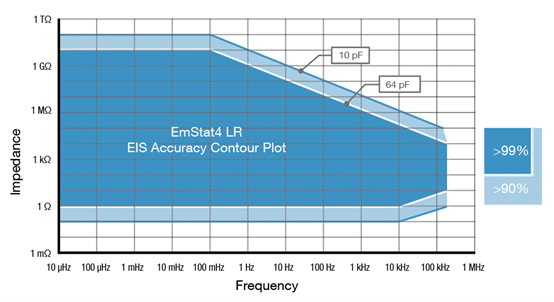
| EmStat4 LR EIS Accuracy Contour Plot |
|---|
|
Note The accuracy contour plots were determined with an ac-amplitude of ≤10 mV rms for all limits, except for the high impedance limit, which was determined using an ac-amplitude of 250 mV. The standard cables were used. Please note that the true limits of an impedance measurement are influenced by all components in the system, e.g. connections, the environment, and the cell. |
Connector options
We offer flexibility with a variety of connection options
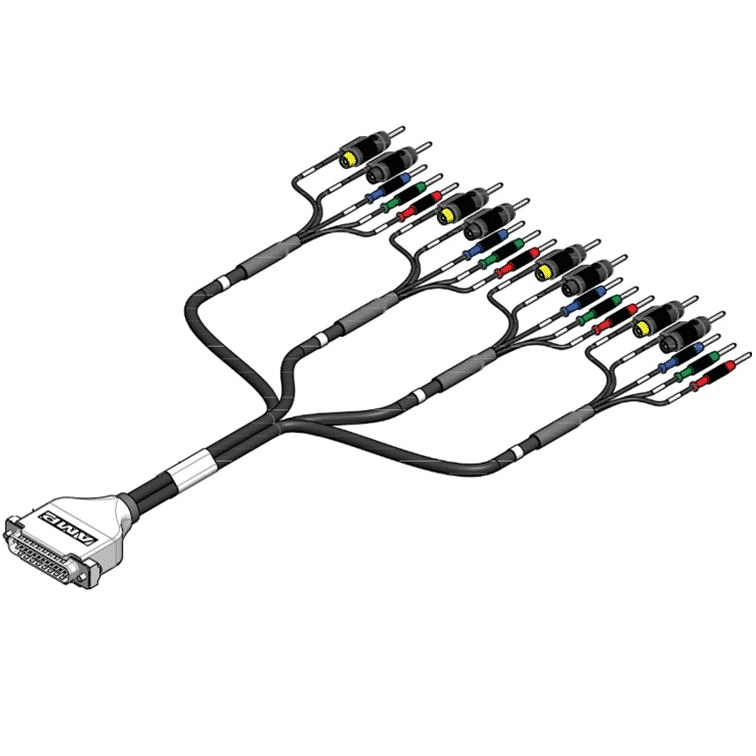
There are four sensor connection options available, each supporting connection to four channels. When you add the RackMount16 to your basket, four units of your selected connection option will be included, providing connectivity for all 16 channels of the RackMount 16CH
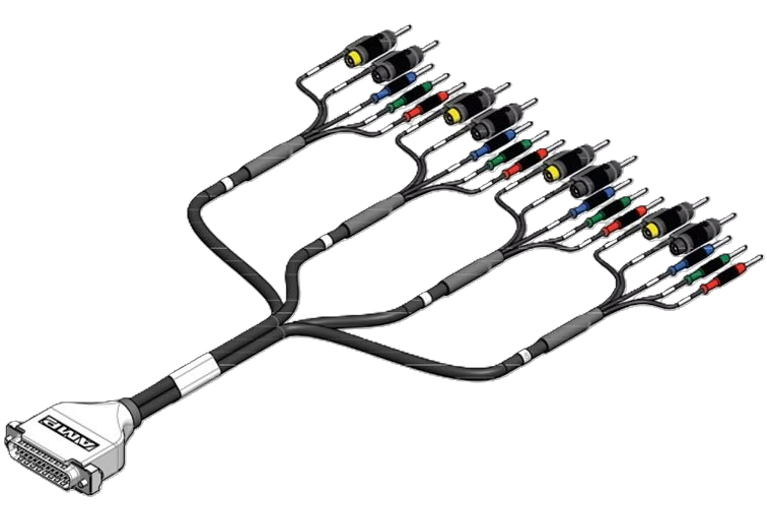
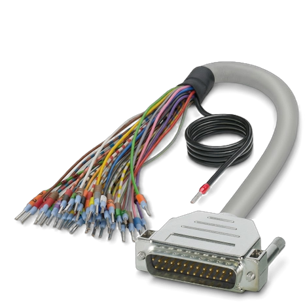
Option B: High-density cable that terminates in ferrules.
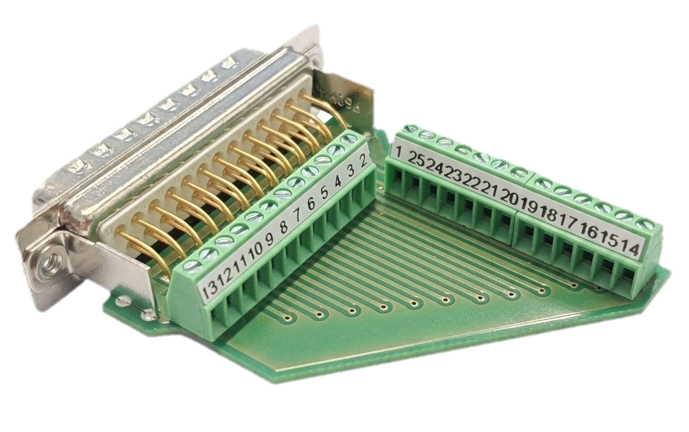
Option C: Connection (Screw) Terminal to assemble your own wires.
You may also like…

Software
PSTrace Xpress for Windows
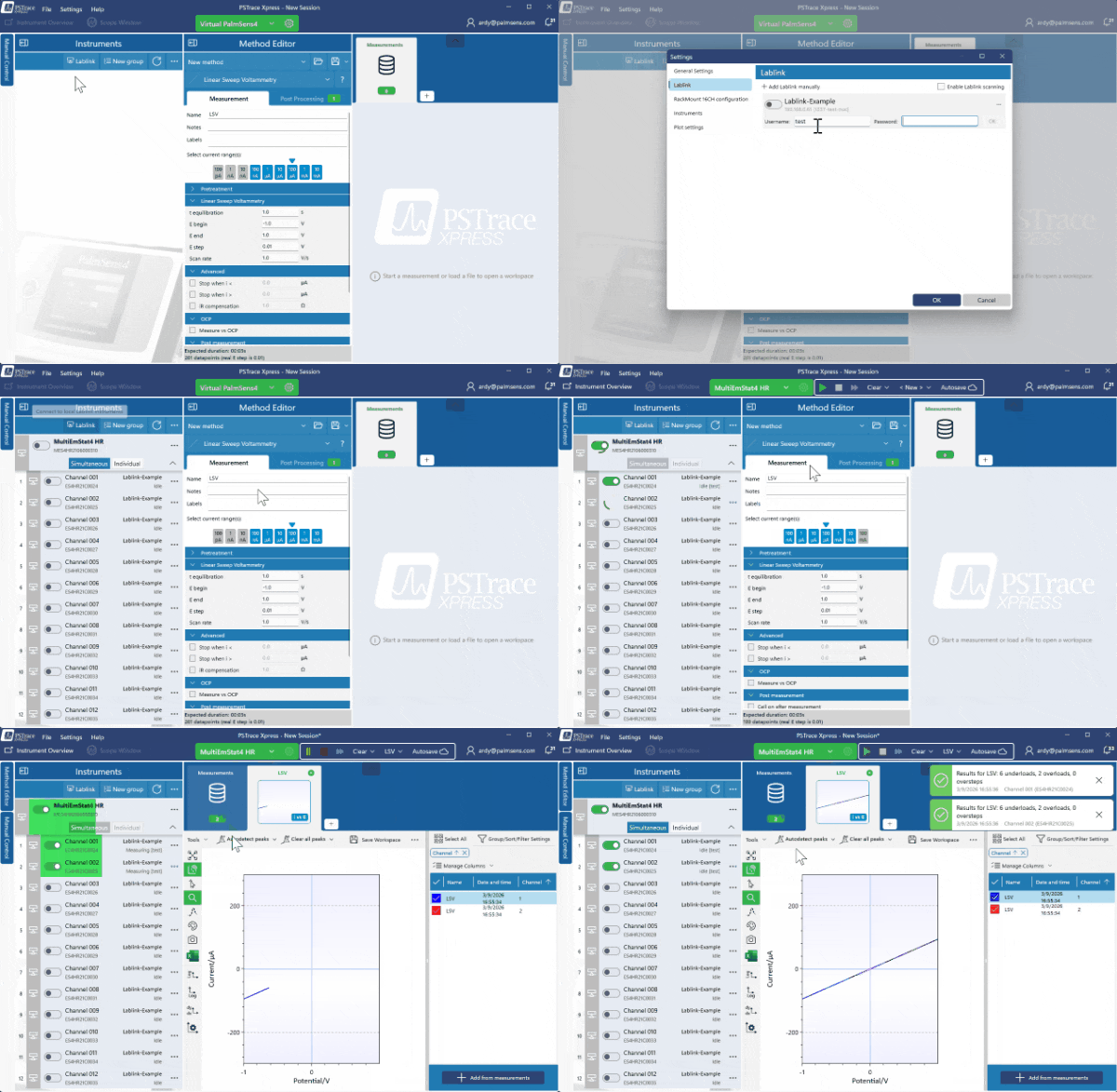
The RackMount 16CH comes with PSTrace Xpress for Windows. PSTrace Xpress is designed to simplify the handling of multiple measurements, and it gives you greater flexibility and control over your experiments. PSTrace Xpress allows the instrument to be controlled via your Local Area Network (LAN) via the built-in Lablink.
MethodSCRIPT™ communications protocol
The RackMount 16CH works with MethodSCRIPT™, giving you full control over your potentiostat channels. The simple script language is parsed on-board, which means no DLLs or other type of code libraries are required. MethodSCRIPT™ allows for running all supported electrochemical techniques, making it easy to combine different measurements and other tasks.
MethodSCRIPT can be generated, edited, and executed in PSTrace Xpress with a future software update.
MethodSCRIPT features includes:
- (Nested) loops and conditional logic support
- User code during a measurement iteration
- Exact timing control
- Simple math operations on variables (add, sub, mul, div)
- Data smoothing and peak detection
- Digital I/O, for example for waiting for an external trigger
- Logging results to internal storage or external SD card
- Reading auxiliary values like pH or temperature
- and many more…

Downloads
| Name | Type | Last updated | |
|---|---|---|---|
| RackMount 16CH EU Declaration of Conformity Learn how to connect the instrument, understand the specifications, use the features and troubleshoot if needed. | Documentation | 04-10-26 | |
| RackMount 16CH-ES4 Brochure Brochure of the RackMount 16CH-ES4, with 16 channels. Read more about the housing options, cell connection options, supported techniques and how to remotely connect to your instrument. | Documentation | 19-08-26 | |
| RackMount 16CH Operator’s Manual Learn how to connect the instrument, understand the specifications, use the features and troubleshoot if needed. | Documentation | 19-08-26 |