


What is a battery analyzer?
A battery analyzer, or battery cycler, is an electronic instrument designed to measure and control the voltage and current of a battery or battery prototype. It applies various signals, such as constant voltage or current, voltage ramps, and alternating current (AC), to evaluate electrochemical properties and battery performance.

Functions and Measurements
A battery analyzer provides detailed insights into key battery characteristics, including:
- Open Circuit Voltage (OCV or OCP): Measures the battery’s potential at different states of charge.
- Charge and Discharge Voltage and Current: Monitors voltage and current during cycling.
- Capacity Determination: Evaluates how much energy the battery can store and deliver.
- Electrochemical Impedance Spectroscopy (EIS): Assesses internal resistance and reaction kinetics.
- Polarization Curves: Analyzes power efficiency and electrochemical performance.
Differences in naming of electrochemical techniques
| Battery Analyzer | Potentiostat (for general Electrochemistry) |
| Open Circuit Voltage (OCV) | Open Circuit Potential (OCP) |
| Constant Voltage (CV) | Chronoamperometry |
| Constant Current (CC) | Chronopotentiometry |
| Linear Polarization | Linear Sweep Voltammetry |
| Cyclic Polarization | Cyclic Voltammetry (CV) |
As potentiostats were originally developed for basic electrochemical research, they use terminology that may be familiar to electrochemists but less so to battery scientists or engineers. As examples, here are some techniques that have specific names, with their equivalents for potentiostats:

Typical requirements for a battery analyzer
Battery testing often involves higher current levels and longer experiment durations compared to other electrochemical experiments. Some durability assessments require thousands of charge-discharge cycles, extending over days, weeks, or even months. The ability to maintain stable operation over extended periods is essential to ensure reliable data collection and uninterrupted testing. In addition, battery researchers often rely on specialized data visualization methods that facilitate comparative analysis of battery performance.
Ready to start measuring? Read how to connect a potentiostat to a battery for the lead connections, four-terminal EIS and safety tips.

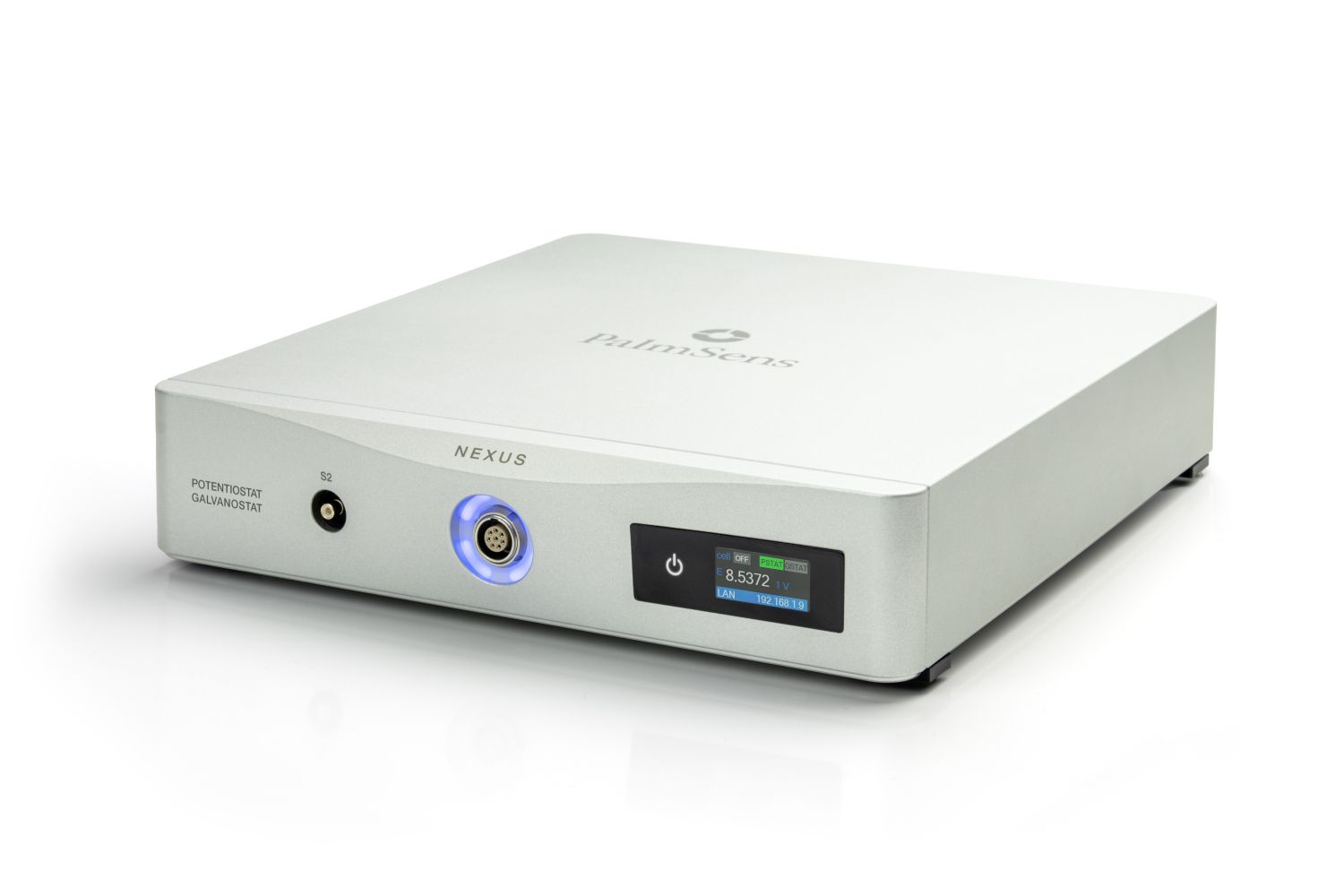
Battery Analysis with the Nexus
The Nexus can deliver and measure currents up to ±1.1 A, enabling realistic cycling of coin cells, pouch cells, or small cylindrical cells. Its 32 GB internal storage ensures that even long-term cycling experiments can be performed without continuous PC connection.
Multi-Channel Scaling
Battery research often requires testing multiple cells simultaneously for statistical significance. To allow this the Nexus is stackable so multiple instruments can be placed on top of each other. Subsequently, the stacked devices can use hardware synchronization so that all measurements will start at exactly the same time.
MethodSCRIPT Automation
Nexus supports MethodSCRIPT™ automation, enabling fully customizable scripting and precise control of the instrument. With MethodSCRIPT™, you can create complex multi-step procedures and execute your own cycling protocols tailored to specific research needs.
This powerful functionality allows researchers to design advanced workflows such as:
- Sophisticated cycling algorithms with multiple, configurable steps
- Integration with external devices, such as temperature controllers
- Conditional testing, for example triggering an EIS measurement after a specific event