
Articles

Origins of electrochemical potentials
This section is a short explanation of the processes that lead to electrochemical potential and thus to corrosion processes.

Troubleshooting on potentiostat experiments
Here are some general comments on trouble shooting that are valid for any experiment. We made this list to enable even not very experienced users to find the sources of trouble as soon as possible to keep the frustration level for you and coworkers as low as possible.

History of the potentiostat
Knowing the history of a device is helpful to understand certain terminologies or identify obsolete parts of a device that are still used because this is how it was always done.

Potentiostat
A potentiostat is a device that can demonstrate the presence of a certain substance by measuring electrical current. Learn how it works
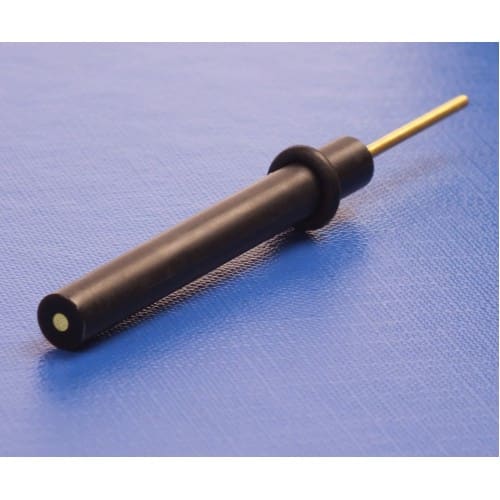
Electrodes used with a potentiostat
This section gives a short overview of the three types of electrodes (working, reference, counter electrode) you will encounter while using a potentiostat. It is explained how these electrodes look like and what their task is.
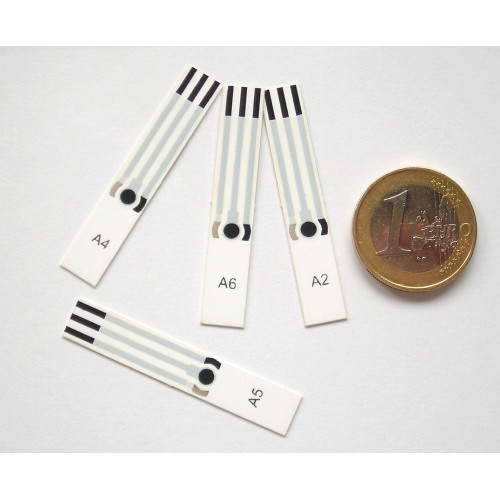
Heavy metal analysis of river water using the IS-HM sensor
This application note provides a comprehensive set of instructions for use of the screen-printed electrode (SPE) IS-HM in analyzing Pb, Cd, and Cu concentrations of a polluted river water sample.
IS-Au – Hg Detection all methods in one bundle
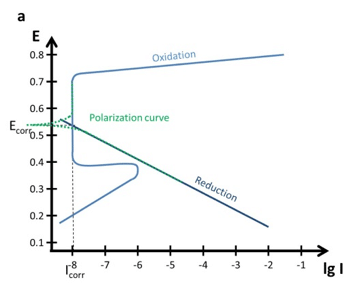
Polarization Curves: setup, recording, processing and features
In this extensive section Polarization Curves are discussed. How to setup your equipment, the choice of parameters as well as the data processing is discussed. This will enable you to record a polarization curve and extract the corrosion rate from it by using PSTrace 5. Furthermore, the polarization curves and Evan’s diagrams for passivation films (thick and thin) are discussed. This section closes with a brief description of crevice and pitting corrosion.
Mercury analysis using the ItalSens-Au sensor
A comprehensive set of instructions for use of the screen-printed electrode (SPE) IS-Au for determining the Hg concentrations of aqueous solutions.
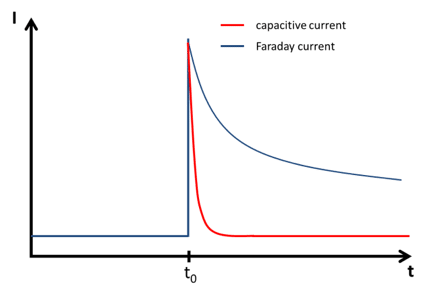
Capacitive Current
If the potential of the electrode is changed, for example during a potential step, the amount of charge the capacitor stores changes, and a current will flow that has no chemical but only a physical meaning. This is the current that charges or discharges the capacitor also known as capacitive charging current or short capacitive current.
Methods for IS-C ItalSens Graphite Sensor Naphthol
Use these methods to measure how to measure naphthol in water with a graphite electrode.
Test Procedure for ItalSens IS-C Graphite Sensors
This application note is used to verify the IS-C (graphite) sensors and their electrochemical stability.
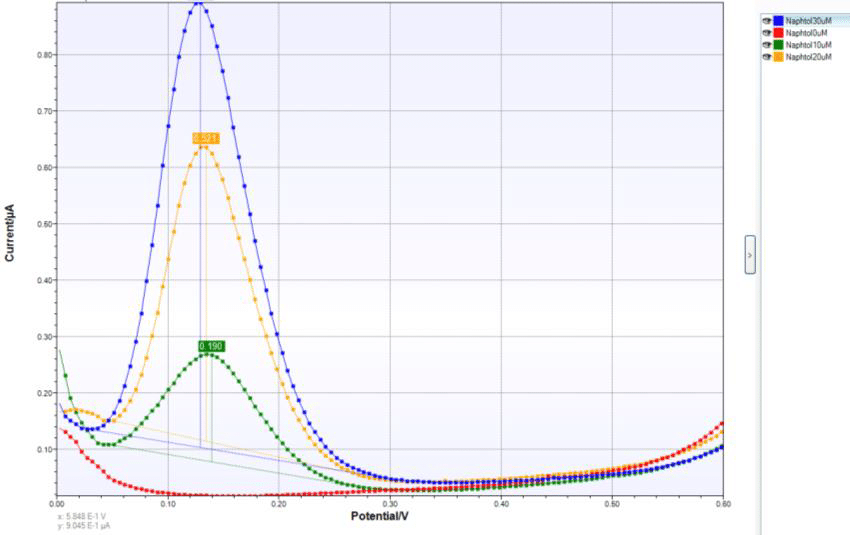
Measuring Naphthol with carbon electrodes (IS-C)
The screen-printed carbon electrodes by ItalSens IS-C have been characterized by measuring naphthol, and can also be used for quantification of naphthol.
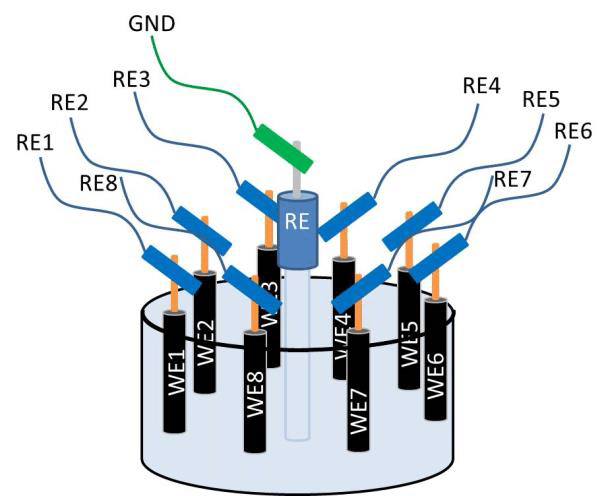
Open Circuit Potential measurements with a MUX8-R2
The multiplexer MUX8-R2 offers the possibility to record reliable Open Circuit Potential (OCP) measurements in the Alternate mode, which allows to monitor the OCP of multiple samples over time with a single potentiostat. In this application note it is demonstrated how to setup and perform an OCP measurement with the MUX8-R2 in the Alternate mode.